https://modelcontextprotocol.io/specification/2026-07-28/changelog
It’s out! New stateless can be more mindful of your local resources and play nicer with software deployment lifecycles and internet infrastructure!
https://modelcontextprotocol.io/specification/2026-07-28/changelog
It’s out! New stateless can be more mindful of your local resources and play nicer with software deployment lifecycles and internet infrastructure!
Model Context Protocol was the big AI development of 2025. It includes a lot of architectural baggage from when it was created and what people were trying to solve at the time. It’s going to evolve or be replaced for sure. But I think the biggest change will be that it will go stateless.
MCP made its first big strides as a way for developers to control the context information fed into LLMs. It’s a way to manage that all important context as a module that isn’t deployed with the LLM. It centered around communicating on one local host, because that’s how developers were creating, testing, and finally deploying applications. It gave dynamic and online ways to manage context that replaced some of what RAG, LangChain, and a lot of custom code was doing.
Most importantly, MCP provides a way to leverage the new technique all the model developers were adding: tool use. The previous architectures had programmers making decisions about the context information. Tool use puts that decision in the hands of the AI model, allowing it to request the context it needs. And the protocol arrived on the scene about the same time tool use started working.
Even MCP wasn’t ready to give all control over to a tool using model. The design was made by the programmers who had been working on controlling context information for years. And so the MCP server retains a lot of control. It does this by making a bidirectional connection from the client to server. The local connections handled this naturally. On the network they relied on HTTP SSE, which is a specialized and not quite popular protocol. SSE is useful for real time updates. This server controlled connection was seen as desirable to developers who wanted to update a context window very quickly. The protocol choice is currently being changed to HTTP Streaming, which is similar and just a little bit more common to see in other applications.
I think this will change. And here’s where they’re working on it. https://github.com/modelcontextprotocol/modelcontextprotocol/issues/1442
State is difficult to handle in software even when it’s known and designed into the system. Sometimes it’s just easier to outlaw any state changes in your architecture. For example, REST is an API style where requests are inherently stateless. Many applications and websites are designed around using that stateless protocol. And those applications work great! In fact they’re easier to develop, easier to test, and so should contain less bugs than similar applications using stateful protocols. Stateless applications can be deployed to a serverless runtime, which lowers development costs and for smaller applications can very significantly lower the cost of running a service.
MCP designated resources, prompts, and tools as the services provided. The server retains some control over all of these even though the AI is operating the client side. The server can provide information about changes without the client even asking about them.
Alternatively, skills have similar goals of retrieving data and making changes, but are entirely serverless. Skills are just the instructions, rather than designing any protocol at all. Where to get the skills has been a more lawless area. And while there is a lot about skills are for instructions and workflows and MCP is about searching and actions, there’s really a lot of gray area where either works.
As tool use gets better we can rely on the AIs more and more to orchestrate the entire workflow of discovery of resources and managing its own context window. This means the control the server was keeping just isn’t helping as much. Then calls to the server can follow a more stateless architecture, supplying the protocol new advantages of simplicity and cost savings. And that’s why I think stateless MCP is coming and is going to be most of the MCP ecosystem.
It didn’t even look like a bad query. It also didn’t take long to realize the quick way to get the work done was a disaster of a shortcut.
The introduction to this requires that I also defend those involved. These were very smart developers working on a system that barely required reporting at the end of a complicated process. I understand how they got there. Take the data you have and put it in a data warehouse. Let the magic and arcane engineers of Google handle the data and processing to get the reporting results you require. You get to just write SQL (or BigQuery’s variant that’s very close to standard) and it just works!
The company tracked packages. Millions of them every day. They wanted to know things about the travel routes and times. The list of ways to measure and describe a shipment was growing quickly with new ideas and new requirements every sprint. To optimize for this dynamic style of development this team designed what I would describe as a Visitor Pattern or a Plugin Architecture. The history and state of a package is sent through an interface to any number of functions that developers were constantly updating and adding to. The functions would all output more data and tie that to the name of the function.
One simple example was a Days In Transit function. It would analyze the information provided and say something like “Days In Transit = 4.” Put an index on that data and you could quickly see how long all the packages had been in transit. There were lots more of these functions doing so many things. Some measuring distance and some judging if there has been a problem. Some functions were making predictions of outcomes, both common and rarely occurring. Some looked at previous predictions and compared how that was going with the new tracking information. Complex stuff. All generating more and more data that could be used in aggregate reports later.
Every package we tracked now had an Kotlin Map structure of these pieces of data. Query by the field you want and you get the data element back. It worked like a dynamically typed language. Which is great. Some packages were first processed under different rules and had different fields. Given how many packages we were tracking it just wasn’t economical to recalculate everything on delivered shipments. Some more recent data had all the newest functions applied. The datastore for this was MongoDB, which handles dynamic objects really well.
Then came BigQuery.
I have 3 main rules of Google BigQuery.
1. Enter any query into the web console and look at the cost estimate before you run it.
2. Select only the columns you need.
3. Try to run one query and get everything you need. Almost always the cost is looking up the data, not the processing time.
BigQuery is a column store, like Redshift, Snowflake, Cassandra, and Parquet format. Each of those is a bit different, but the column rules apply. You save on queries by going wide with your data. You can go very wide. Tons of columns. When you query for the data you want and select the specific columns you need, the rest of the data never needs to be looked up on disk. You can analyze lots of rows because the data was stored by the schema’s columns. But simply, if you have 100 columns and select 1 column, your cost will be 1% of “SELECT *”.
The project was mostly a success by now, we just wanted some reporting on all of the data at once. The dynamic object with all its generated values would end up being shoved into BigQuery with columns of “trackingNumber”, “timestamp”, “fieldName”, “fieldValue”. Not great for a relational database, but terrible for a column store. Every measurement was its own row in the database. To find a set of values you would group by “trackingNumber” and “fieldName”, find the latest “timestamp”, and get the value for each “fieldName”. This visits every single record, not just the ones you’re looking for. It makes it so you’re getting all the data from the entire table, even if you care about one single value.
A second problem with this was that the SQL in BigQuery looked fine. It was only a few lines, and pretty directly described what it was doing to create a report. It ran relatively quickly on large datasets. The effective cost to run this version of the product was 50x what it needed to be to analyze the data we had. It didn’t take long looking at our billing report from Google to start saving the data in a wider column format. Deciding to spend the time to manage the schema and write to new columns got the project’s costs back on track. Compared to letting the original query continue this saved costs on the order of a couple engineer salaries.
Moral of the story is that BigQuery reporting can be expensive or frequently inexpensive and get you the same results. Pay attention to the schema you’re making and work with the technology instead of against it.
My neighborhood has had trouble with service line leaks and keeping track of our water bills.
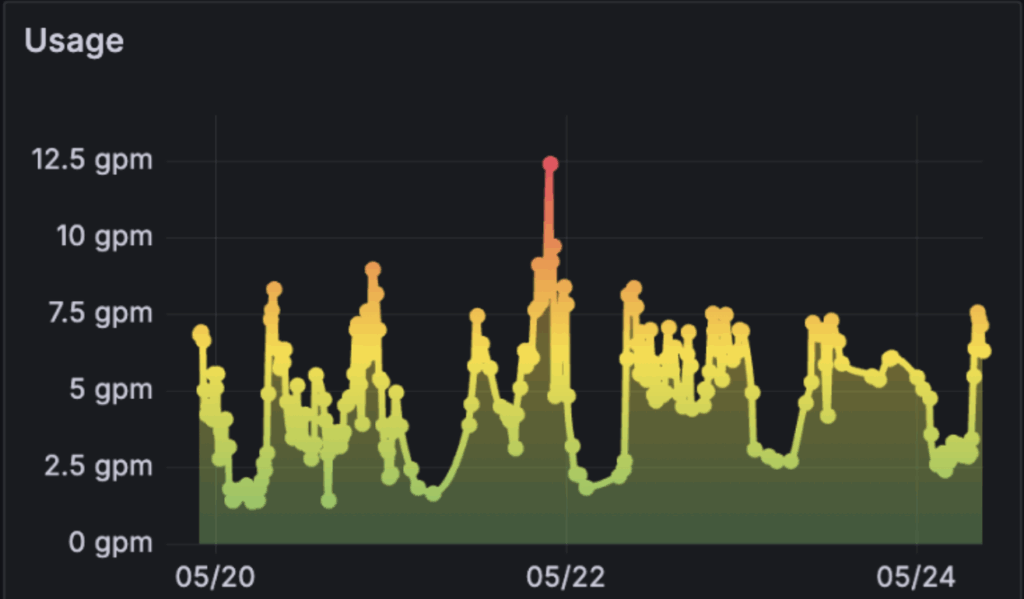
We have one large water meter with bypass for the fire hydrants. But the smaller pipe on the side is probably closer to a normal home water meter. It broadcasts the usage every 15 minutes on a protocol called R900. And it’s in cleartext, so you just need your own radio to receive it.

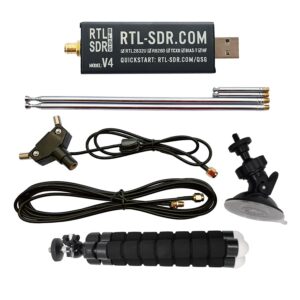
So let’s get our usage the way the utility company gets it. They don’t crawl around underground in the vault reading the meter. They sit nearby and wirelessly get the data.
With just a little bit of configuration I’m uploading data into a timeseries database (AWS Timestream) and running reporting and alerting from Grafana. The alerting is especially useful and has told me about underground leaks before anyone could have known about them, even before the bill came in. Code is on GitHub https://github.com/seanmcnealy/watermeter
That’s the link to download your old O’Reilly books purchases. It’s more difficult to find than ever, with their training subscription business taking over, but the downloads still work today in 2025.
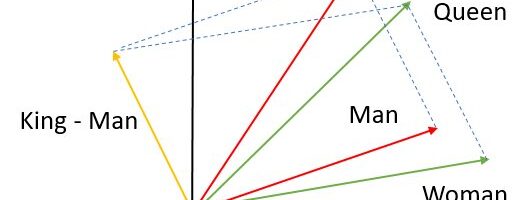
An article by Plotly1 shows how the main analogy for what embeddings represent is a bit shaky. It sounds good and works like the analogies logic from the SAT. But it only kind of works.
I was reading all this stuff about embeddings and it’s really a surprising feature that you could do simple vector math to solve analogies. At first I assumed that the major trained models must have been trained with analogies. You really could create layers that subtract and add embeddings and do supervised learning on a known set of analogies, training the embeddings to represent gender with a single, similar vector. But nobody does this. It seems like just an amazing emergent feature of training the hidden layer we get the embeddings from!
It kind of works. But not quite, and it takes a bit of cheating.2 Taking an embedding vector for King, subtracting the vector for Man and adding the vector for Woman makes a new vector. But the cosine distance isn’t far enough away from King. You have to exclude King, Man, and Woman in order to make this vector close to the embedding vector for Queen.
I tried this myself with OpenAI’s modern embedding model, “text-embedding-3-small”.3 It gives the same results. The closest vector is still King. There’s a lot of error even if you exclude King from the possible results. The embeddings themselves don’t store good analogy information in just linear vector math. The hidden layers and attention heads will still have to work to make the embeddings into something really useful. It’s still neat that we get somewhat close values and it shows something is encoded in these embeddings. The results just don’t work exactly as I’ve been reading and what I’ve been taught about embeddings. I’m not going to start trusting any vector math using real embeddings anytime soon.
This slightly disappointing result does fit some basic intuition. The model wasn’t trained to make vector addition a feature of its values. It’s a bunch of information ready for transfer learning. And what other information is in there? Embedding vectors encode a lot more information, maybe important nuances and maybe extraneous values, in the vector values than you would want in a space made for analogies.
I know there’s a lot of reviews out there. And hopefully you already have these books if you work or intend to work in the software industry. In addition to any language specific books, I believe you should have and read these.
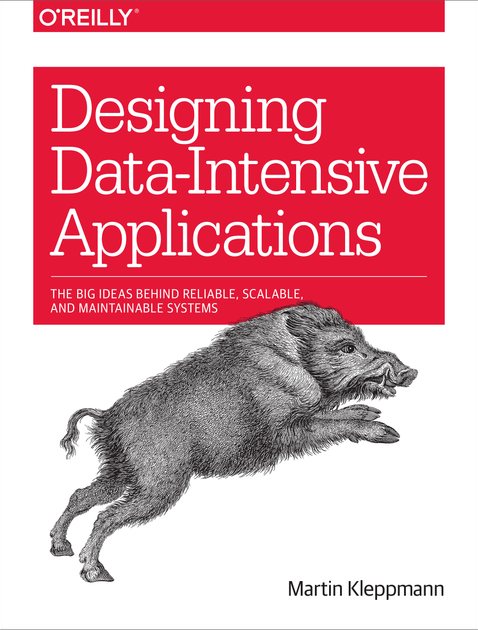
Designing Data-Intensive Applications by Martin Kleppmann
A comprehensive book on actually using distributed systems. You’ll want to know what the effects are from your design choices. And this book goes into databases based on the experiences of someone that’s done this work before you. I read this after prototyping a system, and I think the content here is worth about six months of full time work and research. Plus he has citations if you want to go more in depth.
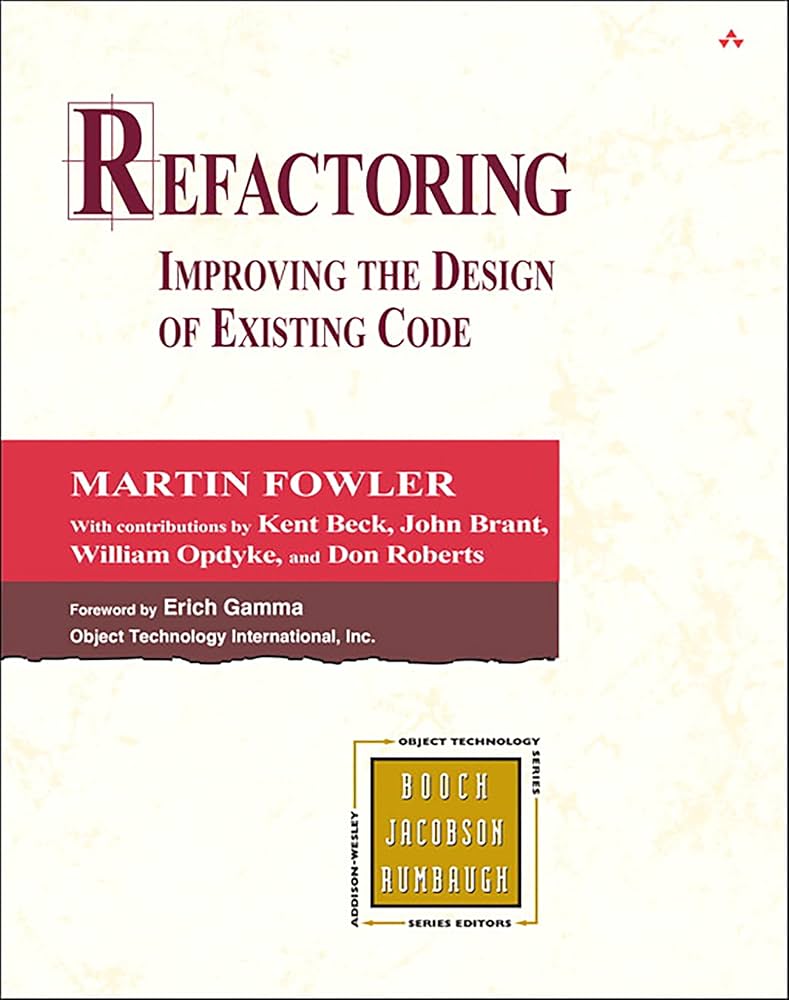
Refactoring by Martin Fowler
Software can change over time and you can change your mind about design choices as the solution changes. Functional or Object-Oriented or IOC or visitor pattern, this walks through practical mechanical steps to show how easy it is to make changes that simplify programs for readability and maintenance. And shows how to go back the other way, too, because maybe that way is better.
You’ll see your programs with many more opportunities to express your designs, and it’ll help you choose for better code.
And I’ll conclude with a short list of books you’ll have to one day see if you study software, but are much less practical. The Art of Computer Programming volumes 1 – 4b, the “CLRS” algorithms book, the compilers “Dragon book.” You’ll have to have them, I guess.

In the US, there is a software engineering license. Is it worth it to become licensed? Is it it feasible?1 No! It’s neither worth it nor feasible.
Engineered products and designs need to show they meet standards and will not harm people. Engineering licensure is one of the activities in some fields that shows expertise at least of a required level to make a correct design. It’s widely used in building design. Licensure is much less used in electrical, computer, or software design. Can a software engineer get licensed this way? A Professional Engineering license can be given in the specialization of Electrical and Computer Engineering.2 That’s pretty close to software development. It may seem like this could be used to make software products more dependable and reliable.
There are general requirements to become licensed. In the US, licensing is done by each state, and every state follows the basic model of engineering licensure (called the Model Law by NCEES), with education, experience, and examination. This is straightforward for some engineers, but difficult for computing professionals. Here are the three major steps and why each is difficult.
Education – A four year degree from an ABET accredited university. IT and CS degrees are beginning to become accredited by ABET, though through their Computing Accreditation Commission. The education piece requires ABET Engineering Accreditation Commission, so many degrees do not count for the education component. Many of the best programs in our field, like Stanford or MIT, do not have this.
Experience – Four years of experience working under a licensed professional engineer. This is rare in industries either under the industrial exemption or under federal certification. Industrial exemption is a rule where a corporation takes responsibility and liability for designs, errors, and omissions and the designer does not require a professional license. Defense, aerospace, medical, even electrical other than power have few licensed practicing engineers. To show how few: there were 13 people passing the Electrical and Computer exam in 2022.3 If you work in computing software or hardware, odds are you do not work directly for one of those 13 people.
Examination – The FE exam and PE exam. The FE exam is so broad and difficult. Computing has moved so fast that even the foundations targeted in the PE exam are difficult to keep constant and stay relevant. Eight hour exams are always difficult.
The results could be considered underwhelming at best. The exam doesn’t prove you’re good at computing work. The requirements for education and experience aren’t a discriminating factor between other education and other experience that turn out to be just as good as what’s accepted for engineering. There’s no guaranteed or even defined career advancement or PE only work. A license is just symbolic of professionalism.
And so, against all the difficulties, and the almost no payoff, I did it. I got a PE license. And this is how.
I went to college at the University of Florida where I had chosen to graduate through the College of Engineering. The Computer Engineering degree program at UF is ABET EAC accredited. No one is choosing computing programs based on this, and I would have happily gone to a school that did not have this feature. Choosing Computer Science or Information Technologies majors would have been a different college than engineering, and would have also worked well for me in every aspect except for this license.
Examination was very difficult. I studied a lot for the FE exam. When I took it in 2008 there was a breadth component that covered all of engineering. Topics range from structural forces to materials to circuits. The PE exam I found easier, but was still only offered once a year in 2023 due to fewer people taking the computing exam.
Experience is basically impossible. But there are exceptions depending on the state board. Alabama will consider whether your supervisor hypothetically could also apply. Washington will consider work for a federal entity or manufacturing as suitable experience (think of Boeing and Lockheed). Florida will use a diploma or copy of official transcripts from your supervisor only if your supervisor has a degree in engineering (think of NASA, Northrop, and L3 Harris). I had no trouble finding PEs in my network of people I know that were willing to recommend me. But I had to rely on Florida’s industrial exemption for my supervisors. If I had lost contact or any of these supervisors were unwilling to help so much or had passed, this would not have been possible.
15 years after I took the FE exam and 4 months after sending in my application, I almost gave up when I had to request an official transcript sent for a retired supervisor who had graduated 50 years prior in another country. I was surprised the university would even do it. University of Alberta was happy to help, but they couldn’t use the newer, faster system. We waited another 3 weeks for that paperwork in the mail.
And there you have it. I can’t recommend anyone else do this. Licensure requires a lot of luck and a lot of following the rules and a lot of waiting. Each of education, experience, and examination excludes too many talented and hard working people for the software field to consider it seriously. On the positive, there are some amazing people working on this behind the scenes. People at state boards, NCEES, IEEE, ABET, and professors at engineering colleges are working hard and doing smart things. They are bringing Professional Engineering forward and making it better for all involved, and including the electronics and computing professionals along the way when they can. Software, hardware, and computing could use some more licensing, or credentialing, or product/process certification than it has today to catch up with other engineering disciplines that are entrusted with safety critical designs and verification, but licensing isn’t ready for that yet.

Costs
I spent 5 weeks in Spain. There’s some benefits to choosing Spain, as it has a quite favorable cost for rent and food, while still being totally modern. See the other posts for thoughts and advice. This one is just numbers.
| Rent | $3,300 |
| Hotels | $1,700 |
| Airfare | $3,800 |
| Airfare for Tourism | $1,400 |
| Food and Restaurants | $4,000 |
| Costs at Home | $500 |
There is more money spent on tourism things. Turns out if you aren’t in Europe often and you’re very close to Paris and London that it’s very tempting to go visit. This added a lot of costs that could have been limited. But watch out, if you have the ability you’ll probably spend a lot in this category.

Time Zones
The most obvious issue. It’s challenging to work several hours from where your coworkers work. Many of us have worked with remote teams, for example Hyderbad or Prague. There’s people that take meetings very early or very late their local time, and they do it every day. That doesn’t make it easy.
The city you’re living in may have more defined hours than in the United States. The rest of the world doesn’t quite have the 24 hour culture of availability. It’s easy to get a Chipotle burrito at noon, 2pm, 4pm, or 8pm. But there may be smaller ranges of hours these things are available. So if you want lunch, let your coworkers know what hours you are taking off for lunch.
Work Expectations
Set some goals ahead of time. Ask your boss what you should be working on.
When you’re far away and some time zones different is a great time to accomplish some of those tasks that you can do alone. Like some of those things you’ve been putting off when new problems get brought to your desk at work to deal with immediately. Think up some tech debt or a cool new feature that you’ve been meaning to finish when you get some time.
Just make sure it’s aligned with what your company, managers, and team members want from you.
Travel Planning
Do a lot of this ahead of time. You will be able to take some improvised trips to nearby attractions. But if things aren’t already planned you’re taking away time from your temporary home to plan things. So have the big things ready to go.
Do you want to take a train or plane to another nearby city? Have the transportation and hotels planned. Maybe even a day trip or museum tickets. Leave some room for spontaneous decisions, but having to work and be a travel agent takes up a lot of time.
Electrical Connectors
Your technology runs on different connectors than the rest of the world. Most AC/DC adapters, like a phone charger or laptop power supply, work on almost every power supply. You just need a safe way plug in a connection. Bring an adaptor everywhere and look up which ones you’ll need in different countries.
What it’s all like
It’s amazing. It’s tiring sometimes. You’ll get a bunch of stories. It’s worth it.
Meeting People
You’re not on study abroad anymore. This is tough now. It’s only getting tougher. We all have technology that connects us to the people we already know. If you’re traveling full time you have the energy and time and ability to seek out those places and times you can meet locals or other travelers. If you’re working and spend many hours in meetings or programming, you’re connected to home instead of where you’ve traveled.
I don’t have a great answer to this. But make sure when you put the laptop away that you’re off of work time. It’s worth it to make that clear boundary even if you don’t define work and home time as much at home.

To the extent possible under law,
Sean McNealy
has waived all copyright and related or neighboring rights to
otherroute.
This work is published from:
United States.
Powered by zBench and WordPress
↑ Top